
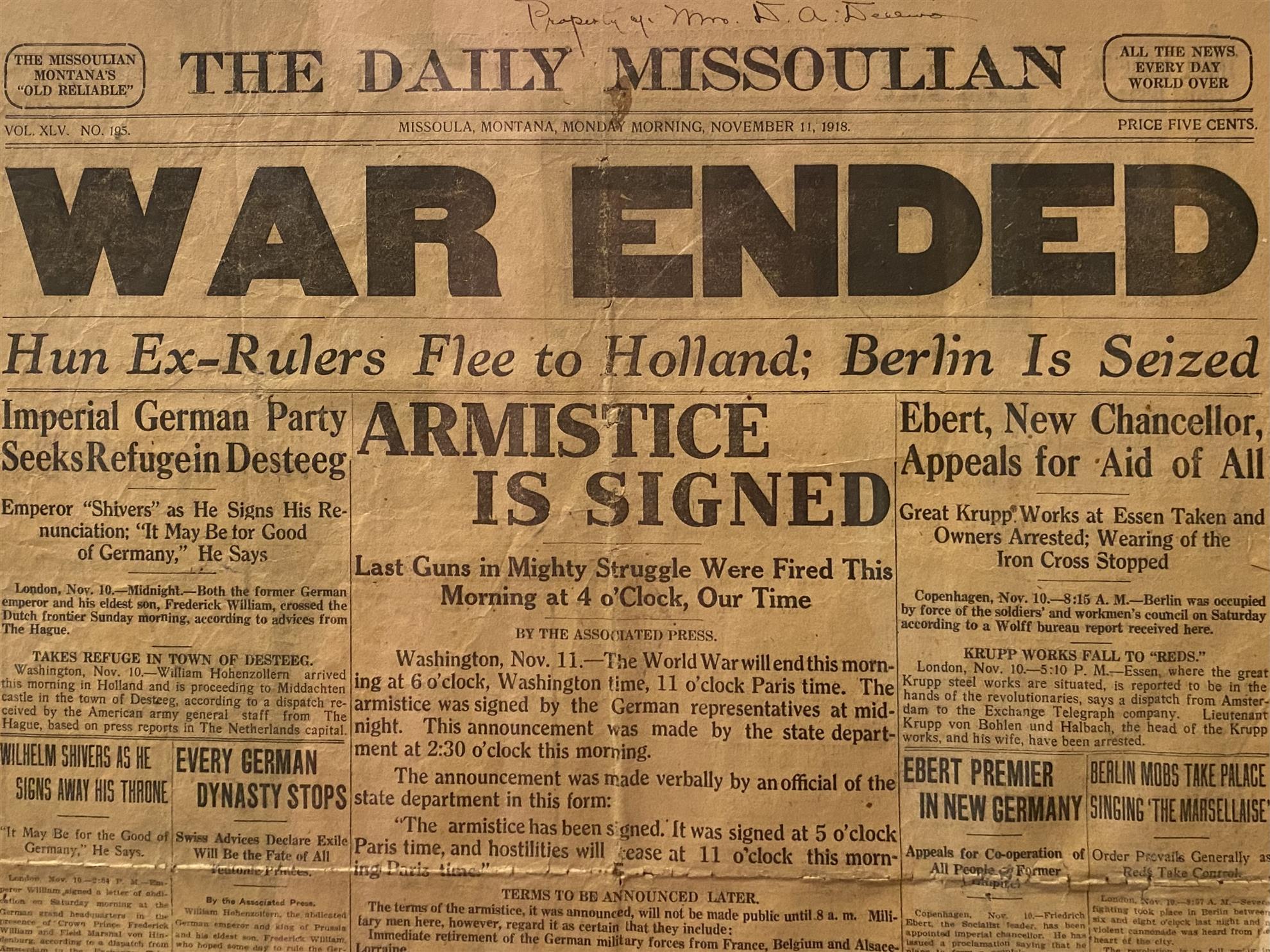
America honored the heroes of our country on Monday. Soldiers who gave the ultimate sacrifice for their country rest in graves all around the world. We honor the fallen each year on Memorial Day. We remember them for their contributions to maintaining our freedom.
The Daily Missoulian pictured above was published in Missoula on “Monday Morning, November 11, 1918” announcing the end of the World War. Many of us had relatives who fought and died in ”The Great War" or “The World War” as it is called in the lede article, and what everyone called it until the world had to start numbering our wars. A statue honoring the doughboys of World War I stands in front of the Missoula County Courthouse.
Several theories exist explaining why infantrymen were called “doughboys" in World War I (1914-1918). The term was typically used to refer to troops deployed to Europe as part of the American Expeditionary Forces. The term became popular around 1914 and was used until the early 1940s when it was gradually replaced by “G.I.” as the next generation enlisted to serve in World War II.
One theory suggests the term dates back to the Mexican War of 1846-1848. American infantrymen made long treks then over dusty terrain, making them look like they'd been covered in flour, or dough. Others say that the men were coated in adobe soil and as a result were called "adobes"," which morphed into “dobies”, and eventually “doughboys.”
According to “War Slang” by American journalist Paul Dickson and lexicographer H.L. Mencken, the slang could be traced to the Continental Army soldiers who kept the piping on their uniforms white through the application of clay. When it rained, the clay on the soldiers' uniforms turned into “doughy blobs,” supposedly leading to the doughboy moniker.
However the nickname originated, it was only one of many nicknames given to those who fought in the Great War. “Poilu," translated as “hairy one,” was a term for a French soldier because many wore beards or mustaches. One slang term for a British solider was “Tommy,” an abbreviated version of Tommy Atkins, the British version of our American generic name John Doe.
The last WWI doughboy, Frank Buckles, died in 2011 in West Virginia at age 110. Buckles enlisted in the Army at age 16 in August 1917, four months after the U.S. entered the conflict, and drove military vehicles in France. One of 4.7 million Americans who served in the war, Buckles was buried at Arlington National Cemetery.
On this Memorial Day, we honor all the men and women who fought and died for our country.
Read more about the doughboys in history.com, source for this story.